
-
Amazon Deals - ToS - Like us?
You are using an out of date browser. It may not display this or other websites correctly.
You should upgrade or use an alternative browser.
You should upgrade or use an alternative browser.
Airtel downgrading 200mbps plan to 100mbps for existing subscribers?
- Thread starter TungaBunga
- Start date
- Replies 31
- Views 964


Kyle Crane
Crane
I have PTSD from 2015 or something
when Airtel charged like 1000Rs for 512kbps unlimited
why do they love 512 Kbps so much
jeez even after being profitable they just want to increase tariffs and buy new yacht or something
when Airtel charged like 1000Rs for 512kbps unlimited
why do they love 512 Kbps so much
jeez even after being profitable they just want to increase tariffs and buy new yacht or something

Airtel argued in front of TRAI around 2019 - 2020 that 512 Kbps is more than enough as the minimum broadband speed and that the proposed 2 Mbps is too high and won't be used much.

warpspeed
To Infinity and Beyond!
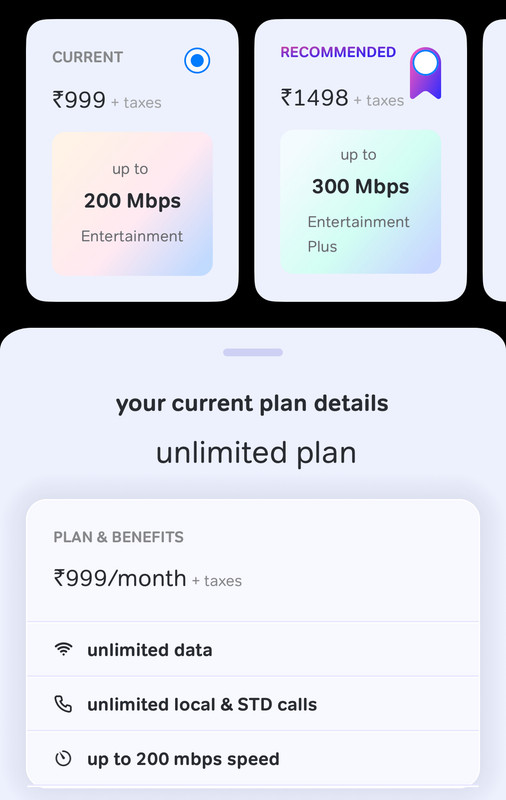
Still seeing 200 Mbps on app. Response from CC is mixed. Some say I should get 200 Mbps regardless of Airtel dropping it, while others claim it is discontinued and existing subscribers are moved to the new 100 Mbps plan.
Thinking of cancelling it and opt for Office Internet instead.
Kyle Crane
Crane

singtel singapore which has stake in Airtel
offers FTTR service ,promising 1gbps to every room
and here is Airtel India ,downgrading speeds and planning to go back to 2012 levels

- Messages
- 344
- Location
- Gurugram (Gurgaon)
- ISP
- Airtel FTTH (Business),
Airtel COIP Primary,
Jio Prepaid (Backup),
Vi Prepaid Secondary.
ISPs never worry about total data consumption, but they want to set limit on consumers i.e. 3300 GB/Month and such.
And TRAI say minimum 2 Mbps speed, that's why these ISP gives 2 Mbps after FUP hit.
Majority of users only care about Internet/Wi-Fi/Broadband keep working and never buffer while streaming. They don't care about how much speed of plan they opted initially.
that is why ISP like JIO/Artel still sale 10/30/40 Mbps plans. Whereas even local ISP gives minimum 100 mbps.
For business plans, many offices does not even need 1 gbps line but these sales guys trick office owner to opt for 1 gbps.
Furthermore, If you're streaming too much of NF/AMZN/HS and other OTT in 4k and have more than 2-3 UHD TVs and and couple of Mobile devices and Desktop/Laptop consuming data simentensoly only then you would need a 200 or Plus Mbps otherwise 100 Mbps is enough. Since Airtel knows, majority of consumers only using 100 mbps or less speed plans and were looking for free OTT bundle so maybe that is why they removed 200 mbps (which they should not), but these ISPs are greedy and want to get more money from consumer pocket and i believe that is why they kept 100 mbps options with more bundles and then 300 mbps option directly.
And TRAI say minimum 2 Mbps speed, that's why these ISP gives 2 Mbps after FUP hit.
Majority of users only care about Internet/Wi-Fi/Broadband keep working and never buffer while streaming. They don't care about how much speed of plan they opted initially.
that is why ISP like JIO/Artel still sale 10/30/40 Mbps plans. Whereas even local ISP gives minimum 100 mbps.
For business plans, many offices does not even need 1 gbps line but these sales guys trick office owner to opt for 1 gbps.
Furthermore, If you're streaming too much of NF/AMZN/HS and other OTT in 4k and have more than 2-3 UHD TVs and and couple of Mobile devices and Desktop/Laptop consuming data simentensoly only then you would need a 200 or Plus Mbps otherwise 100 Mbps is enough. Since Airtel knows, majority of consumers only using 100 mbps or less speed plans and were looking for free OTT bundle so maybe that is why they removed 200 mbps (which they should not), but these ISPs are greedy and want to get more money from consumer pocket and i believe that is why they kept 100 mbps options with more bundles and then 300 mbps option directly.
Kyle Crane
Crane

Kyle Crane
Crane
In all of this i only have hope with BSNL
atleast they are increasing FUP
Kyle Crane
Crane
I have personally talked on this issue that Indian ISP's are not willing to increase speeds after the 2019 change for last 3 years now
its been 6 years now since the last speed upgrade,i think we deserve even higher speeds for the price we are paying or at least we should abolish the concept of FUP ,cmon man its 2025
anyone who says oh 40mbps is enough and 400gb FUP is enough ,i don't want to interact with you in anyway since you are the ideal customer of Airtel and Airtel is EXTREMELY ANTI CONSUMER
it just proves we Indians cant even dream big.
its been 6 years now since the last speed upgrade,i think we deserve even higher speeds for the price we are paying or at least we should abolish the concept of FUP ,cmon man its 2025
anyone who says oh 40mbps is enough and 400gb FUP is enough ,i don't want to interact with you in anyway since you are the ideal customer of Airtel and Airtel is EXTREMELY ANTI CONSUMER
it just proves we Indians cant even dream big.
- Messages
- 344
- Location
- Gurugram (Gurgaon)
- ISP
- Airtel FTTH (Business),
Airtel COIP Primary,
Jio Prepaid (Backup),
Vi Prepaid Secondary.
Agree with @Kyle Crane even Airtel's 5G gives 150 Mbps as an average in room and in balcony gives 500+ Mbps to me.
So for users who wants broadband with 40 mbps should use only 5G and never opt for a wired connection.
About BSNL, its their service, most of time it is down in many circles, otherwise 10% additional speed and without CGNat (in most of case)
I remember back in 2005 when i was happy with BSNL's 256 Kbps and then 512 Kbps and during nights (2 AM to 8AM i guess) it was 2 Mbps and then moved to 4Mbps and 8 Mbps, how happy I was. And now, even 1 Gbps is slow for me sometimes, lol.
It is true that ISP's should provide more speed instead decreasing.
200 mbps should be minimum speed (atleast) and should given at a price of 799/899 RS/Month.
1 Gbps should be around 2500 Rs/Month (off-course additional 18% GST) and without FUP or atleast 10-15 TB per month.
Once I heard from a top ISP's top level officer (During a personal meet up) that indian ISP does not want to remove FUP or give higher speed because of PIRACY (torrenting and stuff) and I would believe that time. Now, most of sites (Public piracy) has been closed. Users are shift to streaming directly from OTT sites. And that is why ISPs are obtaining more PEER SPEED than Actual Speed.
I wish internet would more cheaper and more speed. I am waiting for the day when indian isp start offering more than 1 gbps plans for homes. Cause less speed means more time on downloads and slow speed means I will spending more time on downloads, that will increase more power consumption for my device. in other words more electricity bills.
So for users who wants broadband with 40 mbps should use only 5G and never opt for a wired connection.
About BSNL, its their service, most of time it is down in many circles, otherwise 10% additional speed and without CGNat (in most of case)
I remember back in 2005 when i was happy with BSNL's 256 Kbps and then 512 Kbps and during nights (2 AM to 8AM i guess) it was 2 Mbps and then moved to 4Mbps and 8 Mbps, how happy I was. And now, even 1 Gbps is slow for me sometimes, lol.
It is true that ISP's should provide more speed instead decreasing.
200 mbps should be minimum speed (atleast) and should given at a price of 799/899 RS/Month.
1 Gbps should be around 2500 Rs/Month (off-course additional 18% GST) and without FUP or atleast 10-15 TB per month.
Once I heard from a top ISP's top level officer (During a personal meet up) that indian ISP does not want to remove FUP or give higher speed because of PIRACY (torrenting and stuff) and I would believe that time. Now, most of sites (Public piracy) has been closed. Users are shift to streaming directly from OTT sites. And that is why ISPs are obtaining more PEER SPEED than Actual Speed.
I wish internet would more cheaper and more speed. I am waiting for the day when indian isp start offering more than 1 gbps plans for homes. Cause less speed means more time on downloads and slow speed means I will spending more time on downloads, that will increase more power consumption for my device. in other words more electricity bills.
Similar threads
- Replies
- 0
- Views
- 2,692
- Replies
- 7
- Views
- 8,128